
Payment orchestration doesn’t always reduce organizational debt—sometimes it just moves it
A payment orchestration platform has not reduced organizational debt if it only makes integrations easier for IT while leaving finance and payment operations with fragmented data, opaque routing decisions and manual reconciliation. Evaluate both the payment connection and the financial lifecycle.
In this article
- 1. Routing isn’t valuable unless the business can understand it
- 2. Integration depth must include data depth
- 3. Visibility should measure money, not just percentages
- 4. Control means financial control too
- 5. More PSPs create optionality—and more operational complexity
- 6. The real test is the unhappy path
- 7. Portability is part of debt reduction
- 8. Optimization must include the customer and the entire money flow
- A short procurement test for merchants
- 1. End-to-end financial traceability
- 2. Comparable performance measurement
- 3. Net-value analysis
- 4. Routing explainability and governance
- 5. Exception management
- 6. Reconciliation readiness
- 7. Portability
- 8. Cross-functional validation
- The bigger picture
Payment orchestration platforms are often purchased with a clear promise:
- Integrate once.
- Access multiple PSPs and acquirers.
- Avoid maintaining separate connections.
- Reduce engineering effort and technical debt.
From an IT and engineering perspective, that is a compelling proposition.
But there is another side to the equation.
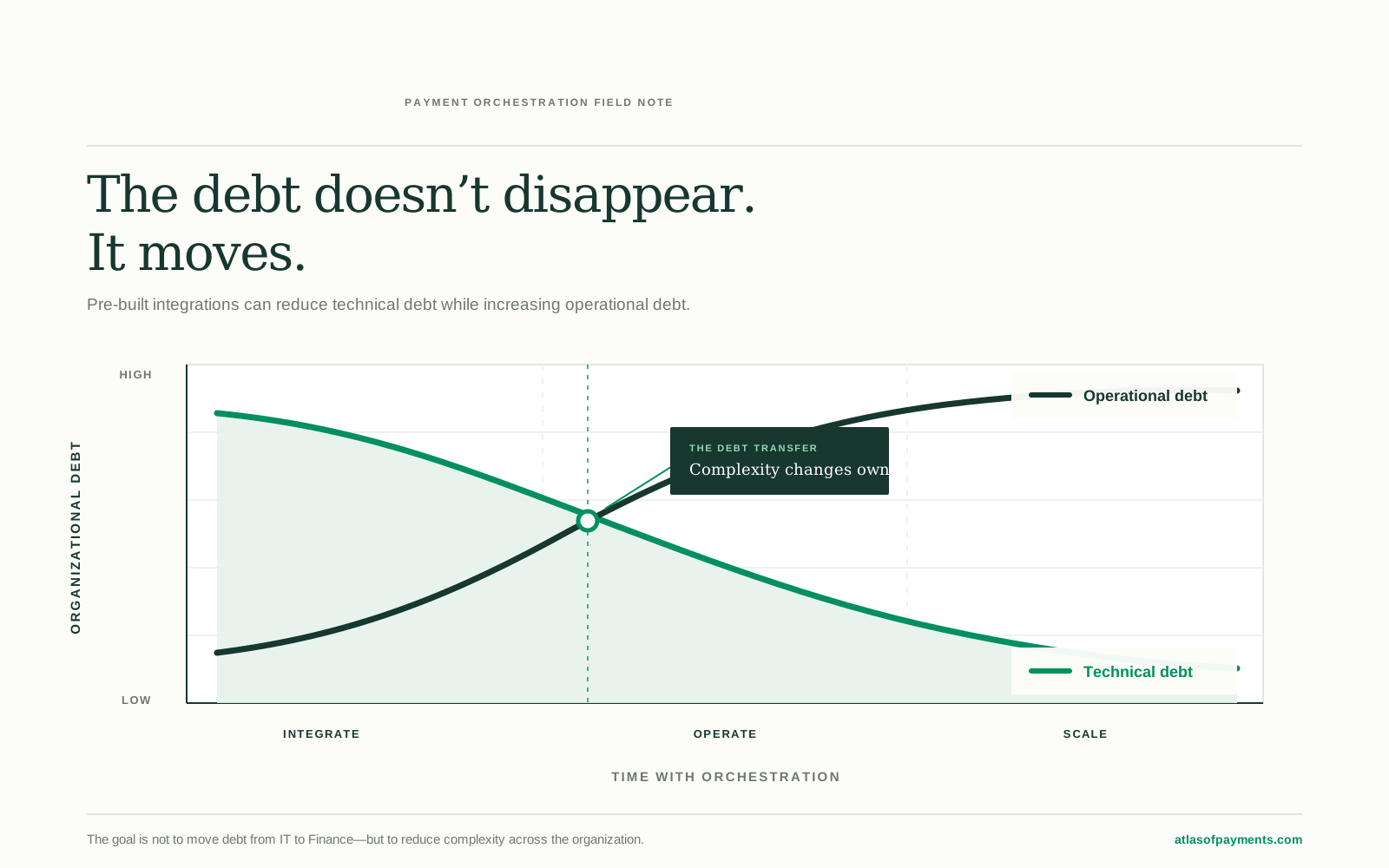
Pre-built integrations may reduce technical debt for IT while creating operational debt for Finance.
That means the CTO or CIO may support the platform because it helps address technical debt and PCI-compliance challenges. The CFO may approve the contract because it appears to be a sensible software investment.
But the largest day-to-day impact may ultimately land on Finance and payment operations.
Engineering no longer has to build and maintain every provider connection. But Finance may inherit fragmented data, inconsistent definitions, opaque routing decisions, and reconciliation processes that still require significant manual work.
The organization has not necessarily eliminated complexity.
It may simply have transferred that complexity from the integration layer to the operational and financial layer.
You may free engineering capacity only to create additional headcount or manual work in Finance.
That is why the first question when evaluating an orchestrator should not be:
How many integrations does it have?
It should be:
Who is buying it, and what problem are they trying to solve?
If IT leads the purchase, the evaluation may naturally prioritize:
- Speed of integration.
- API quality.
- Provider coverage.
- Reliability and failover.
- Security and scalability.
- Reduced maintenance.
Those are all important.
But if Finance and payment operations are not involved, the platform may be optimized for connecting payments without being optimized for understanding them.
Much of the financial validation and operational impact ultimately lands with Finance and payment operations.
They need to know:
- Which routes are actually producing revenue.
- Where money is being declined.
- What each provider owes the merchant.
- Whether fees and settlements are correct.
- Why approval performance changed.
- Whether retries are recovering revenue or distorting the numbers.
- Whether routing is improving economics after costs, fraud, refunds and chargebacks.
This changes how the traditional payment-orchestration criteria should be evaluated.
1. Routing isn’t valuable unless the business can understand it
Connecting multiple providers is table stakes.
The value comes from deciding where each transaction should go based on geography, payment method, cost, risk, availability and expected approval performance.
But every routing decision also creates a data question.
Can Finance see why a transaction was sent to a particular route?
Can it compare the financial outcome of that decision with the alternatives?
Can it separate first attempts from retries, subsequent merchant-initiated transactions, card payments from network-token payments, and authenticated from non-authenticated traffic?
If one PSP receives mostly first attempts while another receives previously declined transactions, their headline approval rates are not comparable.
Issuer mix, geography, transaction value, authentication flow and customer profile also affect the result.
If the orchestrator does not preserve that context, the routing engine can reinforce its own assumptions.
A provider receives easier traffic, produces a higher approval rate, and is then rewarded with even more easy traffic.
The routing appears intelligent, but Finance cannot determine whether it is genuinely improving performance or merely validating its own traffic allocation.
Consistent metric definitions and comparable transaction populations are therefore not just analytics features. They are requirements for responsible routing.
2. Integration depth must include data depth
A long integration list can look impressive.
But “integrated” can mean very different things.
Does the connection support:
- Relevant local acquirers and payment methods?
- Recurring and merchant-initiated transactions?
- Authorizations, captures, partial captures, voids and refunds?
- Chargebacks and disputes?
- Provider fees, settlement records and payout data?
- Multi-currency reconciliation?
- Consistent decline and transaction-status mappings?
In markets such as LATAM, every country can introduce different schemes, settlement rules, acquirers and payment methods. A centralized orchestration layer can make expansion much easier.
But supporting the payment flow is only half the integration.
The other half is supporting the financial lifecycle.
If the orchestrator normalizes the API request but does not normalize the resulting financial data, IT has reduced its workload while Finance still has to interpret different provider reports, statuses, fees and settlement structures.
That is technical debt converted into operational debt.
The relevant question is not simply:
Can we send this transaction through the provider?
It is:
Can we understand, reconcile and account for the transaction after it has been sent?
3. Visibility should measure money, not just percentages
A blended approval rate per provider can be easy to report and easy to misread.
A route declining 5% of $10 million represents more lost money than a route declining 10% of $500,000.
Finance needs to see:
- Declined monetary value by route.
- Approval performance across comparable traffic.
- Processing and acquiring costs.
- Retry and recovery performance.
- Refunds and chargebacks.
- Settlement timing and discrepancies.
- Net financial performance after fees and losses.
Predicting whether a transaction will decline before it is sent may improve the initial routing decision.
But the business must still be able to verify whether that prediction created incremental value.
Otherwise, “optimization” becomes something the merchant is expected to trust rather than something Finance can validate.
When approvals fall, the platform should not merely provide a dashboard and leave the merchant to investigate.
It should flag the change, identify the affected segment, distinguish provider problems from issuer or authentication effects, and make the financial impact visible.
Visibility, reconciliation and explainability should be measurable outcomes of the platform—not additional responsibilities quietly transferred to Finance.
4. Control means financial control too
Permissions, audit trails, change controls, scalability and deployment flexibility all matter.
But routing changes are not only technical configuration changes.
They can affect:
- Approval rates.
- Provider costs.
- Settlement timing.
- Liquidity.
- Fraud exposure.
- Chargebacks.
- Customer experience.
- Revenue recognition and reconciliation.
Finance therefore needs appropriate access to routing history, metric definitions, transaction data, fee information and the financial consequences of configuration changes.
A platform should fit the merchant’s operating model rather than forcing Finance to work around a system selected primarily for engineering convenience.
5. More PSPs create optionality—and more operational complexity
More providers can improve redundancy, coverage, cost negotiation and routing flexibility.
But every additional provider may also introduce:
- Another settlement format.
- Another fee structure.
- Another decline taxonomy.
- Another reporting schedule.
- Another reconciliation process.
- Another source of discrepancies.
Provider count is only valuable when the platform can make those providers operationally manageable.
A hundred integrations do not help if the merchant needs one specific local acquirer that is unavailable.
And ten useful providers can still become a burden if Finance cannot compare or reconcile them consistently.
The value is not in the number of connections.
It is in the number of connections the organization can actually operate and understand.
6. The real test is the unhappy path
Most demonstrations focus on successful routing.
Operational debt appears in the exceptions:
- A provider times out after authorization.
- A retry risks charging the customer twice.
- Only part of an authorized amount is captured.
- A refund does not match the original transaction.
- Webhooks arrive late, twice or out of sequence.
- Currency conversion creates a settlement difference.
- A failover provider supports authorization but not the subsequent capture.
- The orchestrator and PSP disagree about the transaction status.
IT may see that the API remained available.
Finance may see an unmatched transaction, an unexplained balance or a manual investigation.
Resilience must therefore be evaluated across the complete financial lifecycle—not only at the point of payment acceptance.
7. Portability is part of debt reduction
An orchestrator should reduce dependence on individual providers.
It should not replace that dependence with a new form of lock-in.
Merchants should understand:
- Who owns the transaction data.
- Whether normalized data can be exported.
- Whether routing logic can be moved or recreated.
- Whether historical reporting remains available.
- Whether proprietary data models make migration difficult.
- What happens to reconciliation and audit records after termination.
If leaving the platform requires rebuilding both the integrations and the financial data model, the technical debt was never eliminated.
It was deferred and concentrated in a new vendor relationship.
8. Optimization must include the customer and the entire money flow
When a payment fails, the question is not only why the provider declined it.
Can the platform help the customer complete the purchase through another route or payment method?
Can the business distinguish a recoverable failure from one that should not be retried?
Can it improve the customer journey without creating duplicate charges or confusing payment states?
As merchants expand, they should also consider whether incoming payments and outgoing disbursements are being evaluated together.
Payment acceptance, refunds, settlements and payouts may be owned by different teams, but they are all part of the same movement of money.
Optimizing one part without visibility into the others can create new operational problems elsewhere.
A short procurement test for merchants
Before selecting a payment-orchestration platform, ask the vendor to demonstrate the following using realistic transaction and settlement scenarios—not only presentation slides or happy-path demos.
1. End-to-end financial traceability
Can Finance follow a transaction from authorization through capture, fees, settlement, refund and chargeback?
Can the platform connect the operational payment event to the corresponding financial records?
2. Comparable performance measurement
Can approval performance be compared across equivalent traffic?
Can the platform distinguish first attempts from retries, customer-initiated transactions from merchant-initiated transactions, and authenticated traffic from non-authenticated traffic?
3. Net-value analysis
Can the merchant calculate the value of a route after processing costs, acquiring fees, fraud losses, refunds, chargebacks, retries and settlement timing?
Does optimization consider net financial value or only approval rates?
4. Routing explainability and governance
Can the platform explain why a transaction was sent to a particular provider?
Can Finance and payment operations review routing changes, metric definitions and configuration history?
Are changes auditable and reversible?
5. Exception management
What happens when a provider times out, a webhook arrives twice, a partial capture fails, or the orchestrator and PSP report different transaction statuses?
Can teams resolve these exceptions inside the platform, or must they manually combine data from several systems?
6. Reconciliation readiness
Does the platform normalize fees, settlements, statuses and transaction identifiers across providers?
Can it identify missing settlements, unexpected fees and unmatched transactions without requiring Finance to build a second data-normalization layer?
7. Portability
Can the merchant export transaction data, normalized financial records, reporting history and routing configuration?
What would the merchant retain if it changed providers or left the platform?
8. Cross-functional validation
Have IT, Finance, payment operations, risk and accounting tested the platform using the same scenarios?
Has each team confirmed that the platform reduces its workload rather than merely moving that workload somewhere else?
The bigger picture
A payment-orchestration platform should not be evaluated exclusively as a technology purchase.
IT understands the cost of building and maintaining integrations.
Finance understands the cost of interpreting, reconciling and controlling the money flowing through them.
Payment operations understands the exceptions.
Risk understands the exposure.
Customer teams understand what happens when a payment fails.
The orchestrator cannot independently solve every organizational or data problem. The merchant must still define its metrics, ownership model, accounting requirements and source of truth.
But the platform should support that operating model instead of making it harder to implement.
If only IT participates in the decision, the business may select a platform that successfully reduces integration work while substantially increasing financial and operational work.
That is not debt reduction.
It is debt relocation.
The best orchestrator is therefore not simply the one with the most integrations, the smartest routing claims or the cleanest technical architecture.
It is the one that reduces complexity across the organization:
- Technical complexity for IT.
- Data complexity for Finance.
- Reconciliation complexity for payment operations.
- Decision complexity for payment teams.
- Risk complexity for governance teams.
- Failure complexity for customers.
Before choosing a platform, bring IT, Finance and payment operations into the same evaluation.
IT can verify that an orchestrator connects the payment stack.
Finance and payment operations must verify that the business can understand and control what flows through it.
A platform has not reduced organizational debt unless it does both.
Then test not only whether the platform can process the payment, but whether the organization can explain, reconcile, control and financially evaluate what happened afterward.