Do Not Honor: The Issuer Confidence Problem Most Merchants Misunderstand
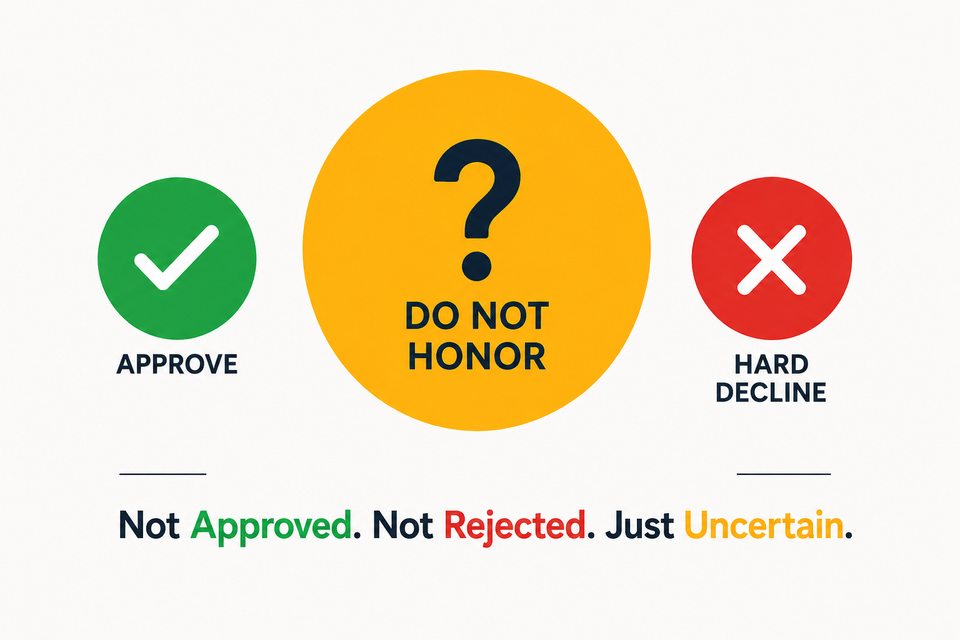
"Do Not Honor" may be the most frustrating decline code in payments.
The issuer isn't telling you the card is stolen.
It isn't telling you there are insufficient funds.
It isn't telling you the customer entered something incorrectly.
It's simply saying:
"We're not comfortable approving this transaction."
The real problem isn't the decline itself. It's the lack of information.
If an issuer says the card is expired, you can update credentials.
If authentication is required, you can trigger 3DS.
If there are insufficient funds, you can retry later.
But when the issuer returns "Do Not Honor," merchants are forced to infer the problem and optimize around probabilities rather than facts.
Many merchants treat DNH as a customer problem.
The best payment teams treat it as an issuer-confidence problem.
The question isn't:
"How do I reduce Do Not Honor declines?"
The question is:
"What signals can I provide to help issuers approve more legitimate transactions?"
Here are 15 practical strategies, ranked from easiest to most sophisticated.
1. Benchmark DNH by BIN, Issuer, and Country
Don't analyze DNH as a single decline bucket.
Break it down by:
- Issuer BIN
- Issuing bank
- Country
- Card type
- Network
A global DNH rate may look healthy while a handful of issuers account for most of the lost revenue.
Start by identifying the issuers generating the largest volume of DNH declines.
2. Measure Approval Rates by Processor
Most merchants monitor overall approval rates.
Fewer measure approval rates by processor and issuer combination.
The same issuer may perform differently across acquiring paths.
If one processor consistently outperforms another for specific issuers or regions, you've uncovered a routing opportunity.
3. Measure Recovery After DNH
Not every DNH decline is permanent.
Track:
- First-pass approval rate
- Retry approval rate
- Revenue recovered after a decline
You can't optimize recovery if you don't measure it.
4. Fix Your Billing Descriptor
Billing descriptors are often overlooked until chargebacks increase.
Issuers pay attention much earlier.
Ask:
- Does the descriptor match the brand customers recognize?
- Is a phone number included?
- Is a website included?
When customers don't recognize a charge, they contact their bank. Over time, that behavior can influence issuer trust.
5. Improve Authorization Data Quality
The goal isn't AVS or CVV.
The goal is issuer confidence.
Sometimes a transaction isn't declined because it looks risky. It's declined because the issuer lacks confidence in the data it received.
Focus on:
- Billing address
- Postal code
- Cardholder name
- CVV where appropriate
- Consistent customer information
The more complete the authorization request, the easier it is for issuer risk models to identify legitimate transactions.
6. Send Richer Transaction Data
Many authorization requests contain only the minimum required fields.
Additional context can help issuers make better decisions.
This is particularly relevant for:
- B2B payments
- Travel
- Healthcare
- Government transactions
Where supported, Level 2 and Level 3 data can provide valuable context.
7. Validate Your MCC
Merchant Category Codes influence issuer authorization models.
Yet many merchants rarely revisit their MCC after onboarding.
Examples:
- Marketplace coded as software
- Subscription business coded as retail
- Travel company coded as consulting
An inaccurate MCC can create unnecessary issuer skepticism before the transaction is even evaluated.
8. Adopt Network Tokens
Network tokens are increasingly becoming an authorization optimization tool, not just a security tool.
Benefits can include:
- Better credential lifecycle management
- Improved issuer recognition
- Reduced fraud exposure
- Higher authorization rates
Many issuers have greater confidence in network-tokenized credentials than traditional PANs.
9. Enable Account Updater Services
Expired credentials create avoidable declines.
Account updater services automatically refresh stored card details when issuers replace cards.
Examples include:
- Visa Account Updater
- Mastercard Automatic Billing Updater
This is one of the simplest ways to reduce unnecessary payment failures in recurring billing environments.
10. Use 3DS Strategically
More authentication does not automatically mean more approvals.
In some cases, excessive authentication can hurt conversion.
Use 3DS where it adds confidence:
- High-risk transactions
- Cross-border transactions
- New customers
- Markets with authentication requirements
Many teams view 3DS as a fraud tool.
Issuers increasingly view it as a trust signal.
Sometimes the issuer isn't asking for less risk. It's asking for more proof.
11. Implement Intelligent Routing
If an issuer consistently underperforms through one acquiring path, route differently.
Options may include:
- Alternative processors
- Alternative acquirers
- Regional acquiring relationships
- Domestic processing paths
The acquiring path matters more than many merchants realize.
12. Localize Acquiring
Cross-border transactions generally face more issuer scrutiny.
A card issued in Germany, Brazil, India, or Japan may perform better when processed through local acquiring infrastructure.
For international merchants, local acquiring is often one of the most impactful authorization-rate initiatives.
13. Build Issuer-Specific Retry Logic
Most retry strategies are too generic.
Different issuers behave differently.
One issuer may approve a retry after 30 minutes.
Another may respond better after 24 hours.
Another may rarely approve retries at all.
Treat retries as an issuer-specific optimization problem.
14. Don't Assume Every DNH Should Be Retried
This is one of the most common mistakes in payments.
Do Not Honor is not a root cause.
It's a generic issuer response.
Behind a DNH may be:
- Authentication requirements
- Credential issues
- Account restrictions
- Risk concerns
- Temporary issuer uncertainty
Before increasing retry volume, understand what is driving the declines.
The best recovery strategies are targeted. The worst simply generate more issuer friction.
15. Preserve Network Tokens and NTIDs Across PSPs
For merchants using payment orchestration, preserving transaction context matters.
Where supported, use:
- Network tokens
- Token references
- Network Transaction Identifiers (NTIDs)
Without those signals, a retry through another processor can appear to be an entirely new transaction.
With them, issuers may have more context about prior authorization attempts.
This is one of the most important questions to ask when evaluating orchestration providers.
Bonus: Engage Directly With Issuers
The largest merchants don't rely solely on dashboards.
They actively review performance with:
- Acquirers
- Networks
- Issuers
Some of the most meaningful approval-rate improvements come from understanding issuer behavior rather than changing the checkout experience.
A Practical Prioritization Framework
Quick Wins (1–4 Weeks)
- DNH reporting
- Billing descriptor review
- Authorization data quality review
- Retry analysis
- MCC validation
Medium-Term Projects (1–3 Months)
- Network tokens
- Account updater services
- Smart retry strategies
- Risk-based 3DS
Advanced Programs (3–12 Months)
- Payment orchestration/Vaulting solution
- Intelligent or rule based routing
- Local acquiring
- NTID
- Issuer engagement
The Real Meaning of Do Not Honor
The biggest misconception in payments is that Do Not Honor means the customer did something wrong.
Often, the issuer simply lacked enough confidence to approve the transaction.
The merchants with the highest authorization rates don't fight declines one by one.
They systematically reduce issuer uncertainty.
They provide better data.
They preserve more transaction context.
They authenticate intelligently.
They route transactions more effectively.
And sometimes, they recover revenue by offering an entirely different payment method instead of another retry.
Ultimately, authorization optimization is less about convincing issuers to say "yes."
It's about giving them fewer reasons to say "no."