The Secret Life of a Credit Card
Most people see a way to pay.
Payment product managers see routing data, fraud signals, authorization clues, and compliance implications.
That 15- or 16-digit number isn't random.
Every field on a card exists because someone in the payment ecosystem needed to solve a problem.
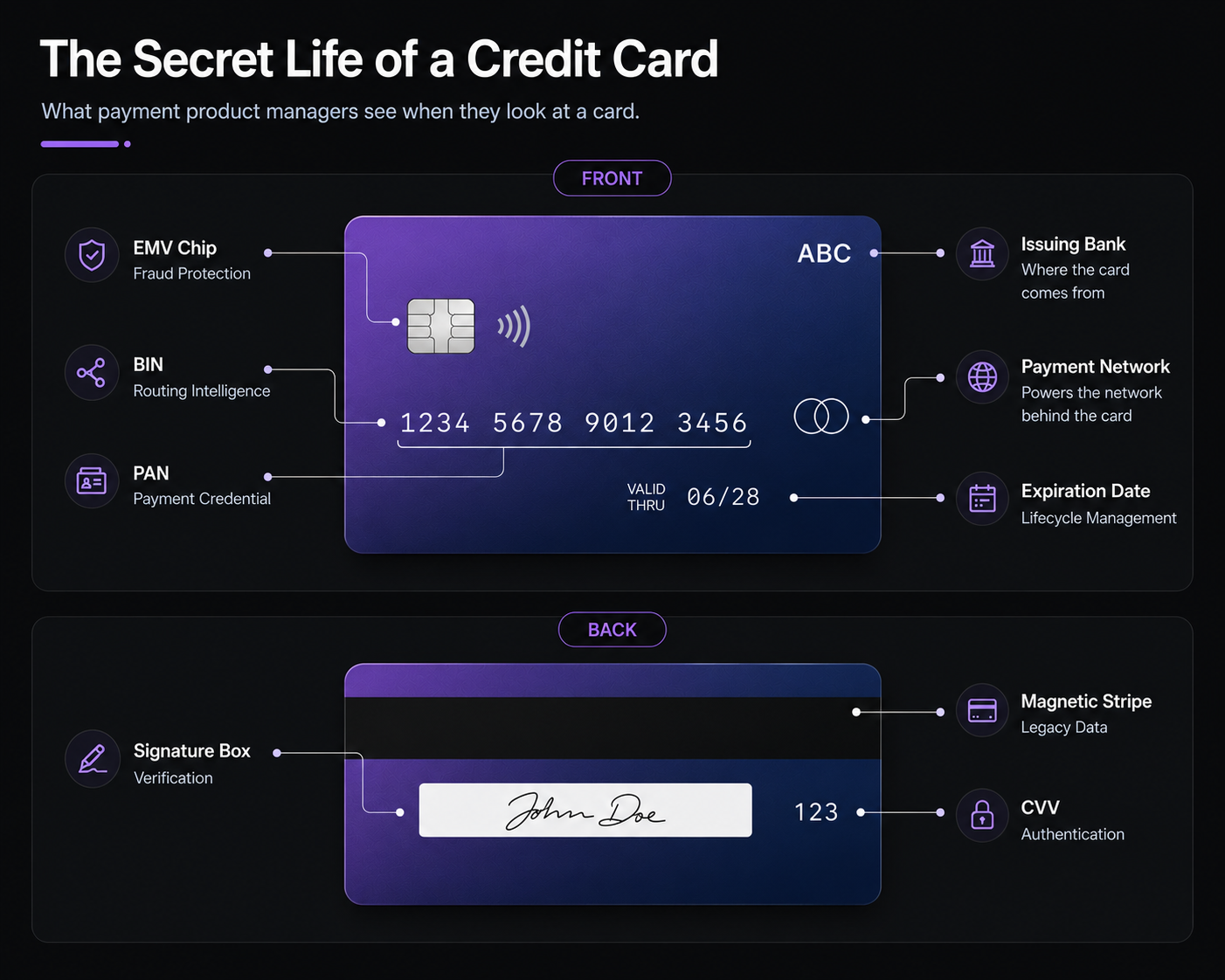
Some fields identify the card.
Some validate it.
Some help prevent fraud.
Others quietly influence how a transaction is routed, authenticated, and authorized.
To consumers, it's just a card.
To payment teams, it's a collection of signals.
And once you understand those signals, you start seeing payments differently.
Before Anything Else: Is This Even a Valid Card Number?
Before a merchant thinks about routing, fraud checks, tokenization, or authorization, there is a much simpler question to answer:
Is this card number structurally valid?
This is where the Luhn algorithm comes in.
In many modern checkout implementations, Luhn validation happens directly in the browser or payment collection iframe before the card is submitted for further processing.
The Luhn algorithm processes the entire sequence of digits, including the final digit (known as the check digit), to verify that the card number follows the expected structure.
Passing a Luhn check does not mean:
- The card exists
- The account is open
- The cardholder has funds available
- The issuer will approve the transaction
It simply means the card number is formatted correctly and is worth processing further.
Think of it as the first quality-control checkpoint in the payment flow.
For large merchants, this small validation helps eliminate obvious mistakes before unnecessary API calls, fraud checks, tokenization requests, and authorization attempts occur.
Practical Nugget
Check your payment collection layer for edge cases.
Certain fleet, fuel, and commercial card programs may use PAN lengths that differ from traditional consumer cards, and some may not follow standard Luhn validation rules.
I've seen situations where payment collection iframes or tokenization providers could not even accept the card because their validation logic assumed a standard consumer card format.
The BIN: The Card's Identity
Once a card passes validation, the next question becomes:
What type of card is this?
The answer starts with the BIN (Bank Identification Number), historically known as the Issuer Identification Number (IIN).
Traditionally, BINs were six digits. Today, many issuers use eight-digit BINs.
The First Digit: The Earliest Routing Signal
The first digit of the card number is called the Major Industry Identifier (MII).
Think of it as the payment ecosystem's first hint about where a transaction is likely headed.
For payment teams, the most familiar values are:
- 3 = American Express and other travel and entertainment cards
- 4 = Visa
- 5 = Mastercard
- 6 = Discover and certain other financial card programs
When a customer enters a card number beginning with a 4, the payment ecosystem already has a strong indication that the transaction will ultimately be routed through Visa.
The remaining digits of the BIN then help identify the specific issuing bank and card program.
Historically, the MII was designed to identify broad industry categories, not just card networks.
In practice, most payment product managers spend their time dealing with the familiar payment-network ranges rather than the broader industry classifications.
The important takeaway is simple:
Before an authorization request is even created, the card has already started providing routing intelligence.
What Can a BIN Tell You?
To a payment product manager, BIN data can be one of the most useful pieces of information available before authorization.
A BIN can reveal:
- The card network
- The issuing bank
- The issuing country
- Debit versus credit
- Consumer versus commercial
- Prepaid versus traditional card
- Product tier and card program characteristics
Before the issuer ever sees the authorization request, these digits can influence real business decisions.
Examples include:
- Which PSP should receive the transaction?
- Should a specific fraud rule be applied?
- Should installments be offered?
- Should a localized checkout experience be shown?
- Should a surcharge or fee rule apply?
- Should this card type be accepted at all?
- Should we expect different interchange economics?
A few digits can dramatically change the path of a payment.
Word of Caution: BIN Data Isn't Perfect
Payments rarely stay simple for long.
Modern card programs increasingly blur traditional categories.
Credit cards.Debit cards. Deferred debit cards.
Commercial cards.Virtual cards.
Fintech-issued cards. Hybrid funding models.
BIN data reflects the issuer's intended product classification.
The authorization response reflects what actually happened.
A card may appear as one product type at the BIN level while behaving differently from a funding, risk, or authorization perspective.
For payment product managers, BIN intelligence is a powerful starting point ; not the final truth.
Practical Nugget: BIN Checks Before or After Tokenization?
One interesting architectural decision appears immediately after a card passes validation.
Should the merchant inspect the BIN before tokenization?
Or should the card be tokenized first and analyzed later?
Different businesses answer this differently.
Some merchants evaluate the BIN immediately after the Luhn check.
This is common when card acceptance rules matter.
Examples include:
Debt repayment businesses that prohibit credit cards and only accept debit cards
Merchants that reject prepaid cards
Organizations with strict interchange-management requirements
If the card will ultimately be rejected, there may be little value in tokenizing it first.
Other organizations prioritize getting sensitive card data out of scope as quickly as possible and tokenize immediately before applying BIN intelligence.
Neither approach is universally correct.
The right answer depends on your business model, card mix, compliance requirements, fraud strategy, acceptance rules, and payment architecture.
The PAN: The Payment Credential
Following the BIN is the account identifier assigned by the issuing bank.
Together with the BIN and check digit, it forms the Primary Account Number (PAN).
This is the payment credential itself.
For most payment product managers, the account identifier portion is not particularly useful on its own.
What matters is that the PAN is sensitive cardholder data.
This single field drives significant compliance considerations.
The moment raw PAN enters your environment, questions start appearing:
- Where is it stored?
- Who can access it?
- How is it protected?
- What PCI obligations apply?
The PAN is arguably the most important piece of information on the card because it identifies the payment credential itself.
It is also the piece of information most likely to expand your PCI scope.
This is one reason modern payment architectures spend so much effort minimizing direct exposure to raw card numbers whenever possible.
Beyond security and PCI compliance, many organizations also want payment credentials that are portable.
A token that only works within a single PSP ecosystem creates a very different set of business options than a token that can move across processors.
The PAN May Not Be Forever
For decades, the Primary Account Number has been the foundation of card payments.
Every checkout flow, payment gateway, fraud engine, vault, processor, and merchant integration was built around it.
Yet the industry is actively working toward a future where consumers may never need to manually enter a card number online.
Major card networks have publicly outlined a vision for reducing reliance on manually entered card numbers through initiatives such as Click to Pay, network tokenization, and modern authentication experiences.
The goal is not to eliminate cards.
The goal is to eliminate reliance on raw card numbers.
Whether that timeline arrives exactly as envisioned remains to be seen.
But the direction is clear.
The industry increasingly wants merchants and consumers interacting with secure credentials rather than raw PANs.
Ironically, the most important field on today's card may become one of the least visible parts of tomorrow's payment experience.
The Last Digit: The Quiet Error Catcher
The final digit is called the check digit.
This is the digit used by the Luhn algorithm.
Its purpose is simple:
Catch mistakes.
If a customer accidentally enters:
- An incorrect digit
- A transposed number
- An incomplete card number
The Luhn validation will often fail immediately.
This prevents bad data from flowing deeper into the payment stack.
It doesn't reduce fraud.
It doesn't improve authorization rates.
It doesn't lower interchange costs.
It simply keeps bad card data from entering the system.
Not glamorous.
Extremely useful.
The CVV: Small Field, Massive Impact
The CVV is probably the most misunderstood field on a payment card.
Many consumers think of it as a password.
It isn't.
The Card Verification Value (CVV), sometimes called a CVC depending on the card network, is a three-digit code on most cards and a four-digit code on American Express cards.
Its purpose is simple:
Help verify that the customer likely has possession of the physical card when making a card-not-present transaction.
For payment teams, however, the most important fact is much simpler:
CVV is considered Sensitive Authentication Data (SAD) under PCI DSS.
Unlike cardholder data such as PAN. The CVV cannot be stored after authorization.
Not encrypted. Not tokenized. Not in a vault. Not for retries. Not for subscriptions. Not for future transactions.
Temporary use during transaction processing is permitted, but long-term storage is prohibited.
This single PCI rule has had a massive impact on how recurring payments evolved.
Recurring payments cannot simply reuse the CVV from the original transaction.
The industry had to build alternative frameworks for future transactions. Network Tokenization / Stored credentials -NTID
I covered this topic in more detail in my article:
"What Is an NTID and Why Should You Care?"
A Small Network Tokenization Nugget
One side effect of traditional card-on-file credentials is the possibility of CVV-related declines and other credential validation issues as stored card data ages.
Network tokenization replaces the PAN with a network-issued credential and uses transaction-specific cryptographic proof during authorization.
The mechanics are complex.
The business outcome is simple:
Fewer credential-related declines and better authorization performance over time.
The Expiration Date: More Important Than It Looks
The expiration date seems simple.
But it serves several purposes.
It helps:
- Validate card freshness
- Reduce accidental misuse
- Support authorization decisions
More importantly, it creates lifecycle challenges.
Cards expire.
Or are about to expire.
Customers forget to update them.
Subscriptions fail.
Revenue is lost.
This is one reason account updater services became increasingly important.
For subscription businesses, card expiration can quietly become a meaningful source of involuntary churn.
The best payment teams think about credential lifecycle management long before cards begin expiring.
From Expiration Date to Credential Operations
For a payment product manager, an expiring card isn't just a date field.
It's an operational workflow.
Questions start appearing:
- Is this credential already provisioned with a network token?
- Have we submitted this card for Card Account Updater (CAU) processing?
- Did the issuer return an updated expiration date?
- Did the issuer return a new PAN?
- Did we receive a "Contact Cardholder" response instead?
A mature payment operation doesn't wait for transactions to fail.
If a credential is approaching expiration, the best teams are proactively managing the lifecycle:
- Running account updater batches
- Monitoring updater response codes
- Identifying cards nearing expiration
- Triggering customer outreach when updates cannot be obtained automatically
For example, if a network token has not yet been provisioned and the last several account updater attempts return a "Contact Cardholder" response, it may be time to proactively ask the customer to update their payment method before a subscription renewal fails.
From the customer's perspective, it's just an expiration date.
From the payment team's perspective, it's an ongoing credential-management process that directly impacts retention, recovery rates, and revenue.
The Service Code: The Metadata Nobody Talks About
Buried inside the magnetic stripe data is a small field called the Service Code.
Most payment product managers rarely interact with it directly, but it exists for an important reason.
The Service Code is a three-digit value that follows the expiration date within magnetic stripe track data.
It helps communicate information about how the card should be processed.
Depending on the card program, it may indicate:
- Usage restrictions
- Service attributes
- International versus domestic usage considerations
- Processing requirements
- Whether certain transaction types are permitted
For example, the service code may help indicate whether a card should be processed as debit or credit in certain card-present environments.
For purely e-commerce businesses, the service code rarely appears in day-to-day product discussions. Though, some of those “mystery” generic declines can be attributed to this Service Code.
The bigger lesson is more important.
Payment cards contain significantly more information than what appears on the front of the card.
The Magnetic Stripe vs. The Chip
The magnetic stripe stores static data including the PAN, expiration date, service code, and verification data.
Because this information remains unchanged throughout the life of the card, it is vulnerable to skimming and replay attacks.
The EMV chip takes a fundamentally different approach.
Instead of relying solely on static data, it generates a unique cryptographic value for every transaction.
EMV originally stood for Europay, Mastercard, and Visa, the organizations that pioneered the standard.
Today it is the global standard for card-present payments.
Even if a fraudster captures transaction data from a chip transaction, that information generally cannot be reused successfully in a future transaction.
The card looks almost identical.
The security model is completely different.
This dramatically reduced many forms of counterfeit card fraud.
It also helps explain why fraud increasingly shifted toward card-not-present transactions, where the chip is no longer present to generate those protections.
Same card.
Different security model.
The Takeaway
A credit card is not just a payment method.
It is a collection of fields, and every field exists because someone in the payment ecosystem needed to solve a specific problem.
The BIN identifies the card.
The PAN identifies the payment credential.
The check digit catches mistakes.
The CVV helps verify possession.
The expiration date helps validate the credential.
The service code communicates processing rules.
The chip protects against counterfeit fraud.
Individually, these fields seem simple.
Collectively, they determine how transactions are validated, routed, authenticated, secured, authorized, and managed.
Most consumers never think about the information on their card.
Payment product managers should.
Because understanding what each field is designed to do often explains why payment systems behave the way they do.
And understanding those decisions is often the difference between building a checkout that merely processes payments and one that optimizes them.