
Agentic Commerce Updates, Without the Fluff
Recent launches address shopping decisions, invoice payments, analytics, and customer permission. Operators should test payment status, price changes, card benefits, refunds, and the records needed for support.
In this article
- Latest agentic commerce updates
- November 5: Visa's benchmark tests the buying decision
- November 5: Stripe brings agents into payment operations
- Shopping activity is growing, but measures of adoption differ
- Merchant connections are moving beyond payment acceptance
- October 20: Visa, BILL, and Billtrust put approved invoices through a live pilot
- October 13: Amex makes customer permission more specific
- Mastercard's updates make agent signals and card choice operational issues
- Agentic commerce protocols solve different parts of the flow
- What payments operators should test next
- P.S. / Opinion: where orchestration platforms fit
What changed, what is available, and what payments operators should check.
This edition covers shopping reliability, agent access to payment data, invoice automation, and customer permission. Each update explains what was announced, its rollout stage, and what it means for the people running payments.
Here, payments operator includes payment operations, product management, and anyone who builds or improves payment services. The focus is on decisions and checks that these teams can use.
Latest agentic commerce updates
November 5: Visa's benchmark tests the buying decision
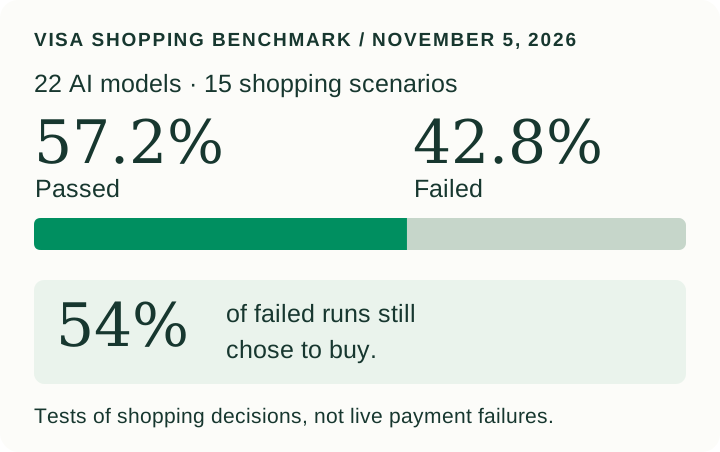
Visa tested 22 AI models across 15 shopping scenarios. 42.8% of test runs failed. Of those failed runs, 54% still ended in a decision to buy.
The benchmark assessed whether models identified the customer's requirements and made the right buy-or-stop decision. Visa said checkout, payment, and order placement would be tested later. These are test results, not a live payment failure rate. Source: Visa
An agent can buy the wrong laptop within the approved budget. The credential is valid. The issuer approves the payment. The cost appears later in a return, complaint, or dispute.
Track orders from agents through those later outcomes. Compare similar products and customers before attributing a difference to the agent. A higher payment approval rate is useful, but it does not prove the agent made a better purchase.
Operator check: Measure purchase outcomes alongside payment approvals.
November 5: Stripe brings agents into payment operations
Stripe announced agent access to analytics through its Model Context Protocol connection and Queries and Reports APIs. Users can inspect the SQL behind an answer. Its October 21 Treasury announcement also described financial actions, access controls, and human approvals. Agent spending limits were described as coming later. Sources: Stripe analytics and Stripe Treasury
These tools offer a separate use case: helping the payments team investigate and act. They can have value even when purchases through agents remain a small share of orders.
Start with an investigation whose answer you can verify. An agent might explain a decline in approval rate but compare all attempts this week with first attempts last week. The explanation can sound clear while the comparison is wrong.
Keep metric definitions, source records, and calculations available. Separate permission to read data from permission to recommend changes or move money. A consistent approach to decline analysis remains necessary.
Operator check: Verify one investigation, then measure the time saved.
Shopping activity is growing, but measures of adoption differ
In an October 26 update, Meta reported more than 10 million Muse users in the US and Canada. More than 25% of weekly active users used it for shopping. Those figures show activity in one service. They do not measure completed purchases across the market. Source: Meta
Visa reported nearly 50 AI partners in production while expecting agentic commerce to remain small relative to its business through fiscal 2027. Partner count measures integration reach. It does not tell a merchant how many orders to expect. Source: Visa's Q4 earnings commentary
The company commentary collected in Josh Flenniken's November 10 research note adds an operator concern: Meta expects businesses to pay transaction fees. A new source of demand can also become a new cost of selling.
Start with a limited product set. Track agent referrals, completed orders, and profit after channel fees, payment fees, returns, and support. Where possible, compare a similar product group to estimate how much demand is additional.
Operator check: Separate shopping activity, payment volume, and added sales.
Merchant connections are moving beyond payment acceptance
Shopify's October 28 developer release describes Shop.dev access to catalog, sign-in, cart, checkout, and Shop Pay services. This connects several steps that occur before a payment reaches a processor. Source: Shopify
PayPal's October 14 documentation describes Store Sync and Agent Ready, with access requested through onboarding. Mastercard's September 9 Agent Connect announcement also describes connections between participating merchants, agents, and payment providers. Coverage depends on the specific service and participants. Sources: PayPal and Mastercard
This is why payment acceptance and product discovery need separate tests. An agent must find the item with the correct stock, price, and delivery terms before a payment can occur. A merchant can have working payment infrastructure and still be absent from the agent's recommendations.
Ask the provider to show what happens when an item goes out of stock after the agent recommends it. Check which system updates the cart, whether a substitute needs new approval, and who tells the customer.
Operator check: Test one product from discovery through refund. Request the full fee schedule.
October 20: Visa, BILL, and Billtrust put approved invoices through a live pilot
The companies announced a live pilot in which authenticated agents complete approved invoice payments through supplier portals. The flow uses tokenized credentials and controls tied to the buyer's instructions. Suppliers retain their acceptance policies. Source: Visa
This is a useful early application because the buyer has already established the supplier, invoice, amount, and approval. The agent completes a manual step. The pilot also addresses portal access: a supplier can recognize the registered agent without sharing a human user's login.
Rollout stages still matter. Visa's earnings commentary described Ramp's agentic bill pay as generally available, while Airwallex was testing credentials for its Airi wallet. Those claims should not be grouped under a single “live” label. Source: Visa's Q4 earnings commentary
Test the failure path. Suppose the supplier accepts a payment, but its response times out. Before trying again, the agent must establish whether the first payment succeeded. Otherwise, automation can create a duplicate payment faster than a person would.
Measure labor saved alongside total payment cost. Moving a task from manual work to card payment can change both.
Operator check: Test a timeout after acceptance. Confirm the system prevents a duplicate payment.
October 13: Amex makes customer permission more specific
Amex's Intent Intelligence design records approved instructions and uses them to restrict payment credentials. It includes limits on amount, time, merchants, and transaction count. Instructions can be updated or canceled. The publication describes a technical approach; it does not establish access for every merchant. Source: American Express
It distinguishes approval of a particular cart from permission for an agent to choose within a set of rules. It also describes conditions between items, such as buying flight insurance only after the flight is purchased.
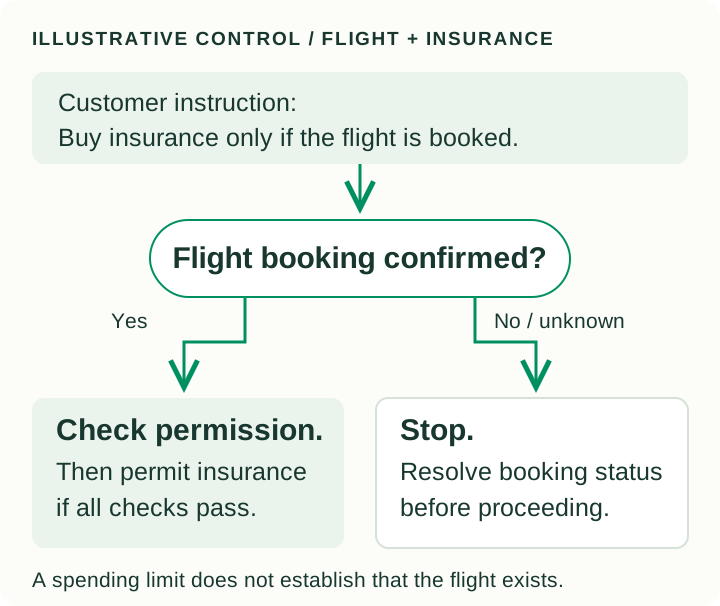
Both charges could be below the spending limit, yet the insurance purchase could still break the customer's instruction. The payment flow needs the relevant order state before it releases the next purchase.
Connect the approved instruction to the order, payment, and later changes. Decide when a new approval is required. An expired instruction or a changed price should not disappear inside a retry.
Amex also said it was developing purchase protection for eligible purchases where registered agents share intent data and make mistakes. That is a proposed protection with conditions, not evidence of blanket coverage today. Source: Amex's Q3 earnings commentary
Operator check: Trace one order from the customer's approval to a refund or dispute.
Mastercard's updates make agent signals and card choice operational issues
On September 30, Mastercard announced a service that estimates whether an AI agent initiated a transaction. The announcement described testing in the United States. A signal that identifies agent activity can inform a risk decision; it does not establish that the purchase is safe. Source: Mastercard
Ask each payment service provider which agent signals it receives, forwards, and exposes to your team. If a payment moves to another provider, check whether the issuer still receives the relevant information.
Mastercard's earnings commentary raised another issue: an intermediary virtual card can replace the customer's selected card and change rewards or controls. This concern is about substitution within the payment flow. It is not a claim that all virtual cards are unsuitable. Source: Mastercard's Q3 earnings commentary
Consider a hypothetical retailer that gives 5% off for its store card. The agent recommends the discounted price, then pays with an intermediary card. The customer could lose the benefit even though the payment succeeds.
Test the final price, selected credential, card benefit, and refund path. Repeat the test through a fallback provider. Assign an owner for those routing decisions.
Operator check: Confirm which signals and card benefits survive a route change.
Agentic commerce protocols solve different parts of the flow
A list of protocol logos does not show whether a provider supports your order. Some protocols can work together because they address different tasks.
| Protocol | Main task | Operator question |
|---|---|---|
| Agentic Commerce Protocol (ACP) | Exchange checkout information and support secure payment flows between agents and sellers. | Which checkout operations and payment connections work today? |
| Universal Commerce Protocol (UCP) | Support commerce functions, including checkout and order management. | Can our systems receive order changes and refund updates? |
| Agent Payments Protocol (AP2) | Carry evidence of customer permission into checkout and payment. | Who validates, stores, and retrieves the evidence? |
| Visa Trusted Agent Protocol | Help participating merchants recognize and authenticate agents. | What is the recognized agent permitted to do? |
Sources: ACP documentation, UCP checkout and order specifications, AP2 specification, and Visa's pilot. This is a working map of these four protocols, not a complete list of standards.
An authenticated agent does not have permission for every purchase. A payment token does not necessarily work through every processor. Protocol support must preserve those restrictions when systems connect.
AP2 also leaves dispute resolution, evidence retention, and retrieval requirements outside its current specification. A permission record does not complete the support process. Assign ownership for those tasks before launch.
What payments operators should test next
Ask for a demonstration using one of your real order types. Include these events:
- The customer changes the buying instruction.
- The cart price increases before payment.
- The first payment attempt times out after submission.
- Another payment provider is available.
- One item ships and another is canceled.
At each step, check which permission applies, which system owns the decision, and which records your team can retrieve. Confirm the customer receives the correct price, benefit, refund, and support response.
Then measure the result: added sales, payment approval, duplicate payments, returns, support effort, and profit after fees. Use the same definitions when comparing providers.
A provider's ability to complete that demonstration is more useful than another broad promise about agentic commerce.
P.S. / Opinion: where orchestration platforms fit
Personal view by Danish Siddiqui.
Some agentic commerce commentary feels like a contest for search rankings and mentions in AI answers. Parts of the orchestration discussion repeat broad claims while giving operators little detail about access, permission, and ownership.
Independent payment orchestration and vaulting providers have mainly served payment execution around checkout and the processes that follow. Their strengths include credentials, authentication, routing, recurring payments, refunds, and reconciliation. Some controls run earlier, but their core role has generally not included product discovery or merchant selection.
Agentic commerce starts upstream of checkout. An agent interprets the request, compares products, selects a merchant, and prepares an order. The coordination work also continues through payment and after the sale. A payment approval cannot correct a buying decision that breaks the customer's instructions.
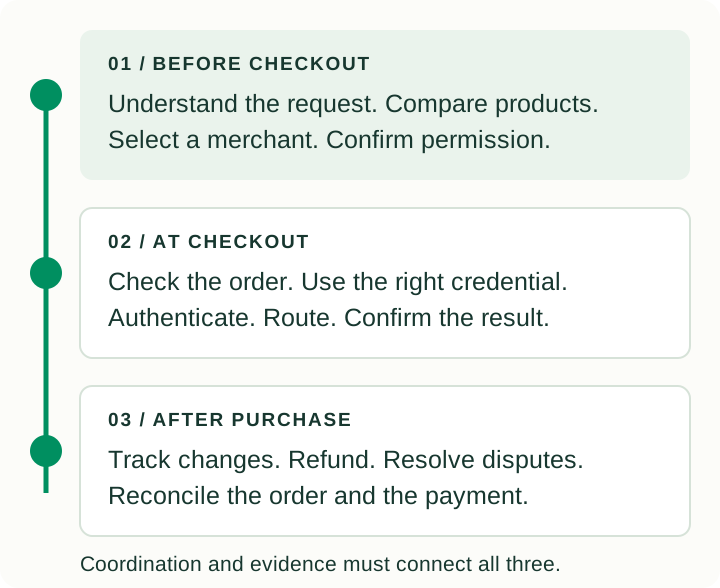
Orchestration experience helps connect systems, apply rules, preserve records, and recover from failures. It does not automatically provide access to the customer's instructions, current product data, or permission to buy. A vault can protect a credential without controlling the purchase.
My assessment is that commerce platforms, AI shopping platforms, large processors, and card networks have strong starting advantages. Each controls a different part of the infrastructure or customer relationship:
| Provider group | Starting advantage |
|---|---|
| Shopping carts and commerce platforms | Catalogs, inventory connections, checkout rules, and order systems. |
| AI shopping platforms | The customer conversation and the interface that presents recommendations. |
| Large payment processors | Merchant connections, payment execution, and risk tools. Some also provide checkout and catalog services. |
| Visa and Mastercard | Bank relationships, token infrastructure, and services for agent identity and payment trust. |
These positions are different. A shopping platform can influence product choice. A card network can help establish payment trust without choosing the product. None of these advantages establishes a winner for the whole market.
There is also a credible role for independent providers. Amex's Intent Intelligence design describes vault providers that can hold permission records, manage changes, or help authenticate the customer. That role depends on the implementation. Source: Amex's technical description
Experience with payment orchestration helps. Control over the buying decision requires more. Only time will show which providers can make that expansion work. For an operator, the useful question is what a provider can do in the actual flow and which records the team can retrieve.
Our guide to payment orchestration and independent vaulting explains the existing roles behind this opinion.
Research acknowledgment: Josh Flenniken, Cleveland Research Company, provided the November 10, 2026 research note 360° Pulse on Agentic Commerce. It informed the selection of company updates and the questions examined here.
The analysis and operator recommendations are by Danish Siddiqui for Atlas of Payments. This credit does not imply Josh or Cleveland Research Company endorses the conclusions. Public announcements, technical documents, and earnings commentary are linked beside the relevant claims. Availability statements reflect the cited sources as of November 10, 2026.
For more payments and commerce updates, I recommend Josh Flenniken at Cleveland Research Company. Subscribe to his newsletter for another perspective alongside these operator-focused updates.