
Payment Optimization Guide for 2027
Payment optimization means finding where payments break down, testing a fix, and measuring what changes. If paid orders fell this week, did fewer shoppers submit payment, did more first attempts fail, or did approved payments fail to capture? Each answer points to a different test.
In this article
- Choose a baseline
- Checkout optimization
- Performance optimization
- How do you A/B test two payment processors?
- When should you stop retrying a payment?
- Keep stored credentials usable
- Cost optimization
- How do you lower debit processing costs?
- Which commercial card payments still qualify for enhanced data savings?
- Technical optimization
- Operational optimization
- Make reporting usable without a ticket
- When is faster funding worth the fee?
- Checkout optimization
- Control the checkout
- Show totals and simplify forms
- Test local methods and 3DS
Measure Paid checkout conversion - Performance optimization
- A/B test PSP routing
- Measure the next retry’s value
- Test token fallback and updater
Measure First approvals and paid orders - Cost optimization
- Route eligible debit at lower cost
- Check interchange qualification
- Verify enhanced data savings
Measure Cost per captured order - Technical optimization
- Trace calls on the payment path
- Reuse gateway and card data
- Reconcile billable calls to fees
Measure Latency and billable calls per order - Operational optimization
- Give operators secure data access
- Match payments to bank receipts
- Set funding and payout deadlines
Measure Time to answer and time to cash
Choose a baseline
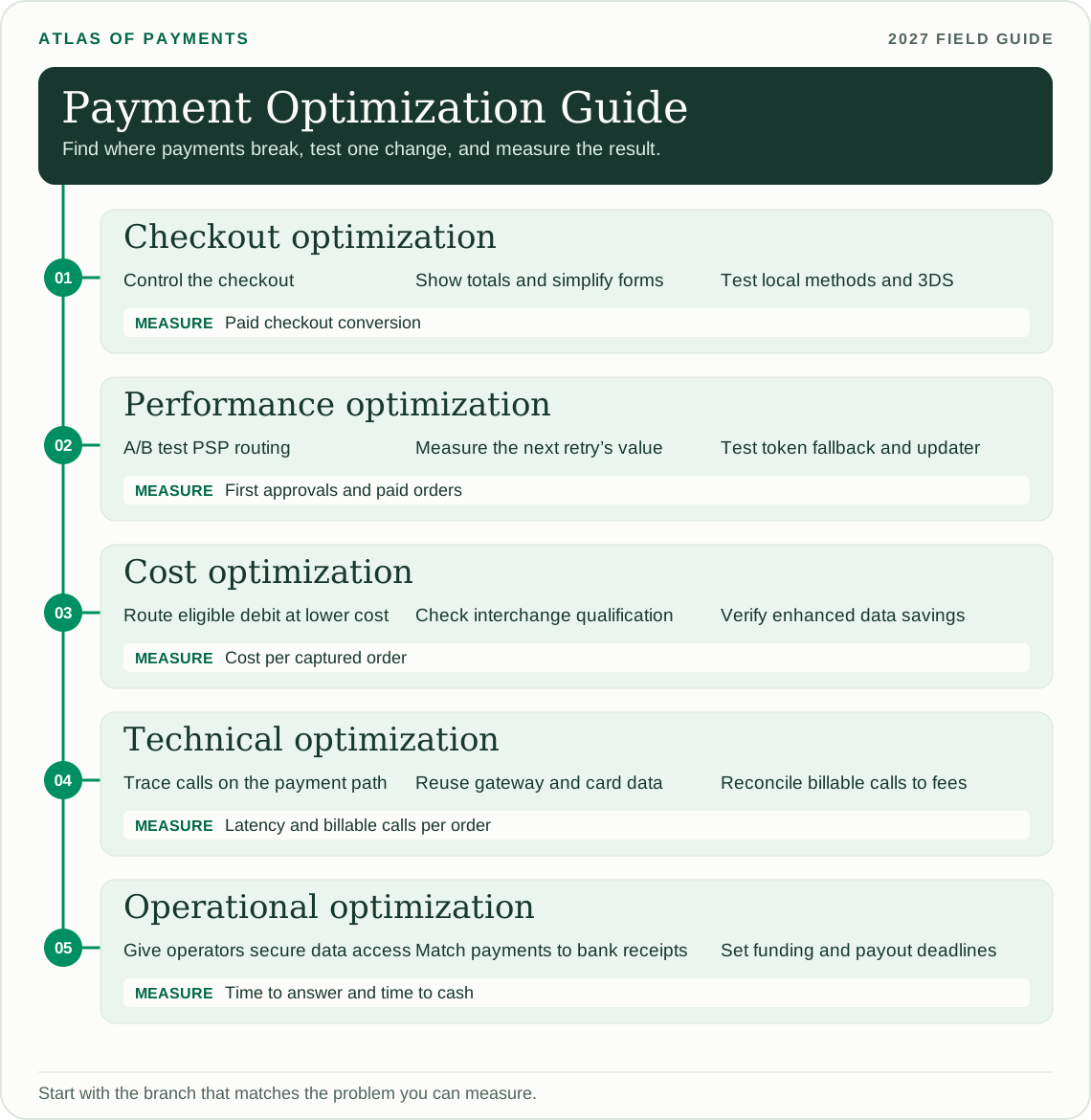
The five chapters cover checkout optimization, performance optimization, cost optimization, technical optimization, and operational optimization. This field guide is for payments operators, operations managers, and product managers. Use it to improve a single processor setup or to evaluate whether payment orchestration earns its cost.
| KPI | Definition to agree before a test |
|---|---|
| Paid checkout conversion | Eligible checkout sessions with a paid order ÷ eligible checkout sessions. Set a completion window for pending methods. |
| First card authorization rate | First card attempts approved ÷ first card attempts sent. Report pre-authorization blocks and unresolved outcomes separately. |
| Final payment success | Unique submitted payment intents that reach the defined paid state ÷ unique submitted intents. Count each intent once. |
| Cost per captured order | Defined acceptance costs, including applicable failed attempts, ÷ captured orders. State what costs are included. |
| Time to usable cash | Time from capture to funds available in the destination account. Track payout variance and reserves separately. |
Pick one primary KPI. Set guardrails for fraud, disputes, duplicate charges, or cash timing as the test requires. Keep the cohort and denominator with every result.
Checkout optimization
Fix the step where shoppers leave.
Map who controls each step before filing a redesign ticket. An ERP may own tax and the order, an ecommerce platform may control the form and guest checkout, and a custom integration may still depend on a provider’s hosted fields. Identify who can change each decision and how quickly.
- Show the total before payment. Estimate tax and delivery as soon as you have enough information. Explain price changes and confirm the final amount before authorization. An online cigar store I worked with needed age verification and destination-specific tax and shipping checks. Asking for the destination early can avoid sending a shopper through a flow for an order you cannot ship.
- Shorten the form and preserve the cart. Use editable autofill, clear inline errors, and guest checkout where possible. Explain mandatory account creation early. Give returning customers an easy way to review or change their saved method and address.
- Test on real phones. Check tap targets, keyboard and screen-reader navigation, load time, and the return from wallets, banks, or authentication. Show eligible Apple Pay, Google Pay, and relevant local methods such as iDEAL | Wero, Pix, or BLIK. Judge the test by paid orders in the market rather than method share alone.
- Keep trust signals and card fields clear. Use recognizable payment marks and explain redirects. Use secure provider fields for card validation. A Luhn check catches many number-entry errors. Apply card-type acceptance rules only where reliable provider metadata supports them.
Handle the moments after Pay. Separate a confirmed decline from a pending or unknown result. Preserve the order and recover its status before allowing a second submission. Put optional offers after clear confirmation. For 3-D Secure, track challenge completion and paid orders alongside fraud. If your payment page is in scope, manage and monitor its scripts under the applicable PCI DSS requirements, including scripts added for experimentation.
Extend deliberately. For omnichannel, confirm which directions of saved credential reuse your provider supports and what consent covers. For agentic checkout, keep catalog data and totals current, decide which flows need human confirmation, and verify the agent’s authority for delegated purchases.
Sources · Baymard checkout research · PCI SSC payment page guidance · EMVCo 3-D Secure · Universal Commerce Protocol
Performance optimization
Improve approvals and recover eligible failures.
How do you A/B test two payment processors?
Randomly split traffic both payment service providers (PSPs) can handle, keep each payment in its assigned group, and compare paid orders, fees per captured order, and time to usable cash.
Check transaction fields, issuer response codes, credential type, and authentication before adding a route. Define eligible traffic by the traits that matter, such as card brand, issuer country, currency, amount band, token type, and recurring status. Log the assigned route, actual first route, fallback, and final outcome.
When should you stop retrying a payment?
Stop when network or processor advice requires it, or when another eligible attempt costs more than the extra payments it recovers contribute.
Use the original decline and any network advice to decide whether to stop, wait, ask for authentication or a new credential, or retry. Resolve timeouts before making another authorization. Ask an orchestration vendor to demonstrate which mappings you can edit, how it handles a mandatory stop or wait, and whether you can set timing, route, and maximum attempts independently. Prevent billing, orchestration, and recovery tools from scheduling competing retries.
Measure success by attempt and cumulative recovery across eligible failed invoices within a fixed window. A flashcard subscription business serving mostly students reported about 40% recovery using timed retries on the same gateway. Insufficient funds accounted for most declines. The denominator and window were unspecified. Rebuild that merchant’s baseline before testing a different schedule or gateway, and count only extra paid invoices against the existing strategy.
In the example below, the fourth retry recovered 12 more invoices. It still lost $12.
Keep stored credentials usable
Test network tokens by issuer, market, gateway, and use case. In merchant work, I’ve seen approval uplift around 2–3% and a reported 11% drop for one gateway in a Latin American market where issuer support was an issue. These field observations lack a common calculation basis. Compare actual approval rates in matched cohorts. For a confirmed token-related failure, test a current PAN fallback through the same gateway when the provider and retry rules permit it. Keep PAN handling within the approved vault or processor environment.
Use account updater for eligible credentials you expect to charge. Remove confirmed closures promptly and act on contact-cardholder advice. Where the provider permits more inquiries, suppress repeated contact-cardholder results after a defined threshold, such as three in a row. One merchant with around 30,000 active customers submitted a vault of about 2 million cards and reported paying $0.20 each time it received that response. Seven avoidable repeats would cost $1.40 per affected credential at that contract rate.
Review disputes by reason. Separate fraud from delivery, cancellation, duplicate billing, and descriptor problems. Fix the source of the dispute, then track losses and fees by order cohort long enough for disputes to arrive.
Sources · Merchant advice codes · Mirte Kraaijkamp on retry ROI · Network token fallback · Visa Account Updater · Visa dispute guidance
Cost optimization
Compare the cost of a captured order.
The new quote saves $1,000 on paper. The live test loses $1,400 in order contribution. Would you switch?
In this example, the quote uses the same modeled payment mix, but the test produces 40 fewer paid orders at $35 contribution each before acceptance fees. Reprice on observed volume and fees before switching.
Reprice the same transaction mix before comparing contracts. With interchange-plus, separate interchange, network fees, and processor markup. Include relevant platform fees, failed attempts, FX, and minimums. Use both fees as a share of captured sales and fees per captured order. Reconcile the quote to real invoices and settlement records.
How do you lower debit processing costs?
Route eligible debit payments through the gateway or processor that can reach the lowest-cost enabled network for that transaction. Compare the full cost of each route, including interchange, network fees, and processor markup. In the U.S., Regulation II protects a merchant’s ability to choose among the networks the issuer has enabled for the transaction, including for online debit. Ask each processor which routes it can actually reach, then compare actual fees per captured order on matched debit traffic and watch approvals and payout timing. Federal Reserve guidance on debit routing
Which commercial card payments still qualify for enhanced data savings?
Visa retired its legacy U.S. Level 2 interchange incentive on April 18, 2026, except for eligible Fleet fuel-only transactions under Commercial Level II Fuel. For other eligible Visa commercial cards, check Product 3 qualification under the Commercial Enhanced Data Program. Mastercard has its own criteria. Ask your acquirer for downgrade detail by card product, merchant category, and transaction type. Verify net savings on settlement records after program fees and any later adjustments. Visa’s U.S. interchange schedule · Braintree’s fleet fuel exception
Sources · Visa interchange and merchant fees · Braintree’s 2026 network updates · Adyen’s enhanced data guide
Technical optimization
Cut redundant API calls.
Trace a normal payment and an exception. Mark each call as essential to the payment, safe to move off the waiting path, or redundant. Ask which administrative and metadata calls are metered and reconcile the counts with the invoice.
- Gateway configuration. Reuse provisioned gateway references and refresh configuration when it changes or on a bounded schedule. Keep live health and disabled-route handling current.
- Card metadata. Reuse permitted provider-supplied BIN data and masked digits already returned by a required call. Refresh when the credential changes. An opaque vault token’s digits do not identify the card issuer.
- Payment status. Use verified provider events where suitable, with bounded checks for exceptions. Preserve idempotency and handle duplicate events and unknown outcomes.
I’ve seen flows with 10–15 calls or more and opportunities to bring the normal path down to three or four. Track latency, timeouts, paid orders, billable calls by category, and fees per captured order. Take the measured volumes to renewal and price them against included allowances, overages, and minimum commitments.
Sources · Gateway provisioning · BIN routing fields · Stripe webhook handling · Idempotency
Operational optimization
Give operators the data and treasury the timing.
Make reporting usable without a ticket
I’ve seen a payments team wait three or four days for a decline report and get an incomplete spreadsheet. An orchestrator can remove engineering work while leaving payments and finance to assemble the data. Give the people accountable for decisions secure read-only access and an owner to contact when a feed breaks. With multiple providers, centralize permitted source records and keep original response codes next to normalized fields.
Connect attempts, captures, refunds, disputes, fees, and payout batches to orders. Match payouts to bank receipts and assign each exception an owner. Track data freshness, time to answer a routine question, match rate, and the value of aged exceptions.
Suppose the seller is eligible for payout today and the customer’s funds arrive in three days. Who covers the gap?
When is faster funding worth the fee?
Pay for faster funding when the value of getting usable cash earlier exceeds the extra fee. Compare the fee with the borrowing cost for the same amount and time, plus any measurable benefit that earlier cash makes possible.
Set the latest date funds need to be usable for inventory, ads, or seller payouts. Forecast by provider, merchant entity, and currency. Card approval, ACH confirmation, settlement, and bank availability run on different schedules. Ask which proceeds are subject to holds, when they release, and what evidence can trigger a review. I’ve seen holds of 25 to 30 days for some higher-risk merchants. Model the terms you have in writing.
At 12% annual borrowing cost, getting $100,000 three calendar days sooner avoids about $99 in simple interest. A $250 acceleration fee needs another measurable benefit, such as incremental contribution from a campaign you can run sooner.
For marketplace payouts, compare eligible instant bank rails such as FedNow and RTP, and stablecoin options where providers and sellers support them. Measure time to usable funds at the destination, including any wallet conversion or withdrawal.
Sources · Atlas on operational debt · Payout timing · ACH timing · FedNow · RTP · Stablecoin payouts
Before you buy a platform. Use one real payment scenario to test routing controls, retry policy, credential portability, fees, reporting access, and cash timing. Ask payments, engineering, and finance to validate the same transaction from first attempt to bank receipt. Atlas’s comparison of orchestration and independent vaulting